

Latest Version
Released:May 28, 2026
Description:
MACCS-UI 5.2.0
SHA1 checksum value:
3bdc604820f4464e56bfa495ff959851882d3709
About MACCS
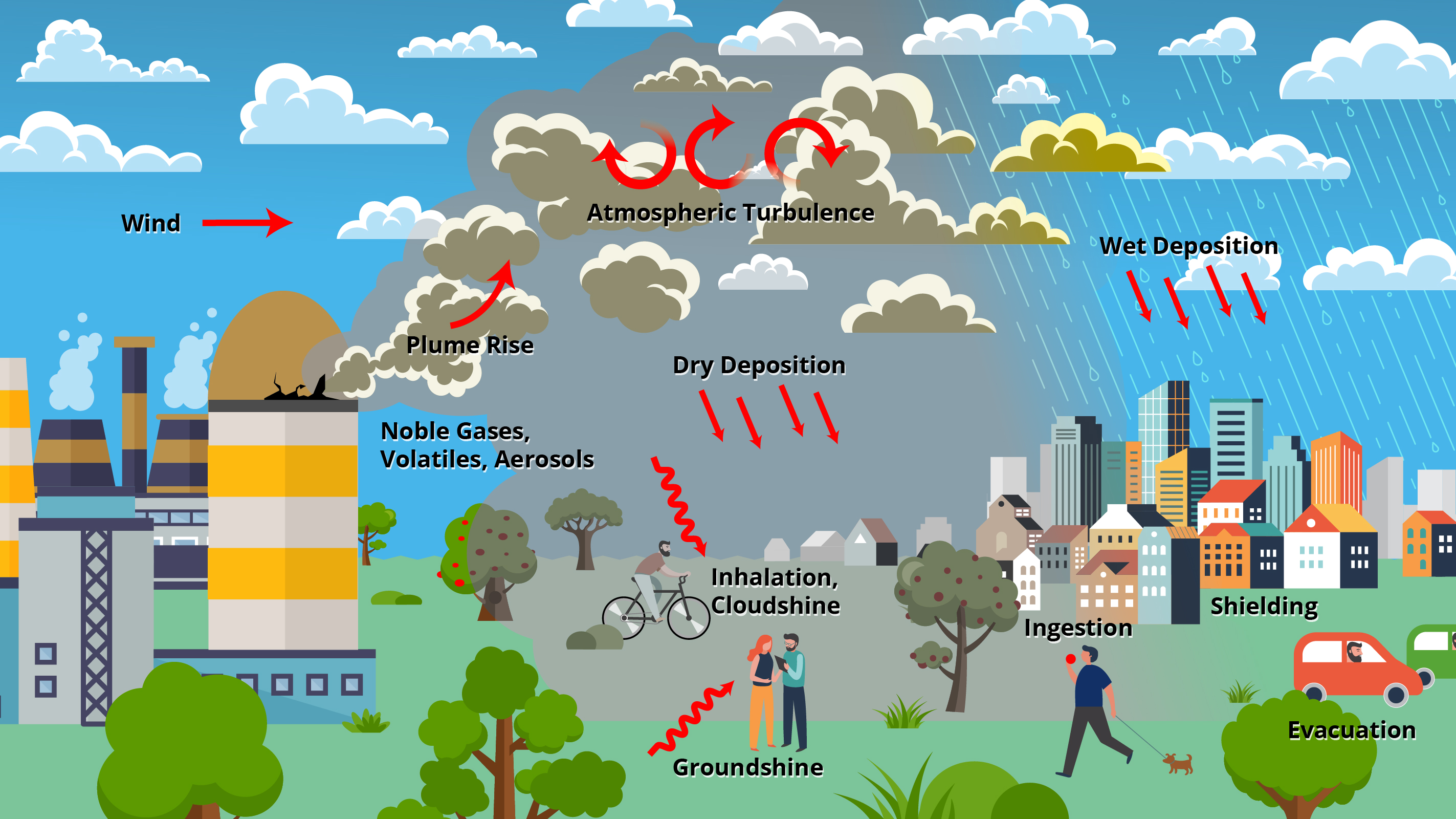
From a given release of radioactive material into the atmosphere, MACCS estimates the extent and magnitude of radiological contamination, offsite doses, protective actions, socioeconomic impacts and costs, and health effects. MACCS simulates atmospheric transport with a straight-line Gaussian plume segment model. Since the weather at the time of an accident is not predictable, MACCS samples from historical weather data as a surrogate for future weather and can run Monte Carlo simulations to evaluate the impact of weather variability. From the estimated air and ground concentrations, MACCS models dose projections through several dose exposure pathways both during and after plume passage. MACCS also models protective actions during the emergency response (e.g., evacuation, sheltering) and long-term recovery (e.g., relocation, farmland restrictions, decontamination) of the accident. While protective actions help reduce dose accumulation to individuals, they also cause social and economic impacts. MACCS models the extent of displaced individuals and land contamination, and the cost of offsite property damage, economic disruptions, and various accident expenditures caused by protective actions. Finally, from the dose accumulation, MACCS estimates early and stochastic health effects according to dose-response models.
MACCS-HYSPLIT Tools is an optional set of utility codes that can help generate input data for a MACCS simulation using resources from the U.S. National Oceanic and Atmospheric Administration (NOAA). These resources include publicly available NOAA weather data and the HYSPLIT code. The HYSPLIT code is an advanced three-dimensional atmospheric transport and dispersion (ATD) model provided by NOAA and one of the most extensively used models in the atmospheric sciences community. In MACCS, users may use the results of a HYSPLIT ATD calculation as an alternative to the original MACCS ATD model. MACCS-HYSPLIT tools include the following three codes:
- MacMetGen: This is a utility code that generates MACCS weather files from NOAA weather datasets or other meteorological sources. Users running the MACCS ATD model may use MacMetGen as an alternative to generating weather data from a site weather tower or other source. Users running the HYSPLIT ATD model should use MacMetGen so that the weather data used in HYSPLIT and the weather data used in MACCS (for other purposes) are consistent.
- GenHysplit: This is a utility code that runs the HYSPLIT code to generate output files of air and ground concentrations.
- HyGridConvert: This utility code converts GenHysplit output files into MACCS input files.
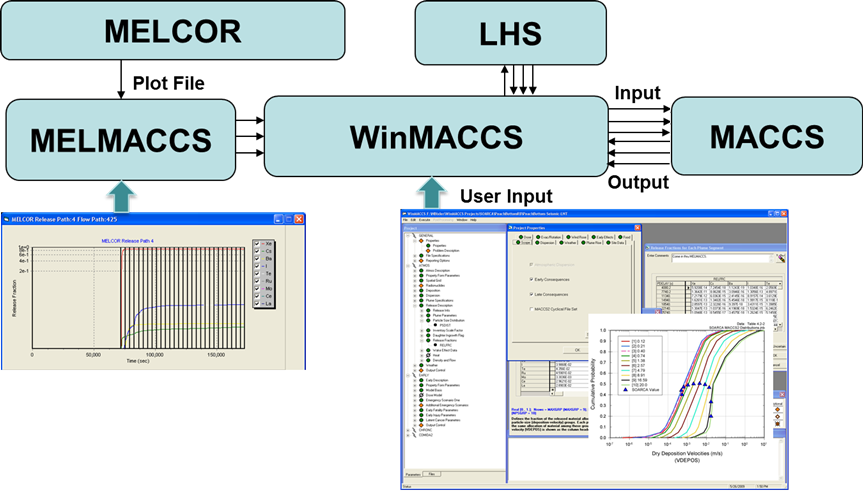
MACCS Data Flow
- User activates modules only as needed to determine results of interest.
- Activated modules determine input files that are required.
- Some required input files may be used as transmitted with MACCS (without user modification).
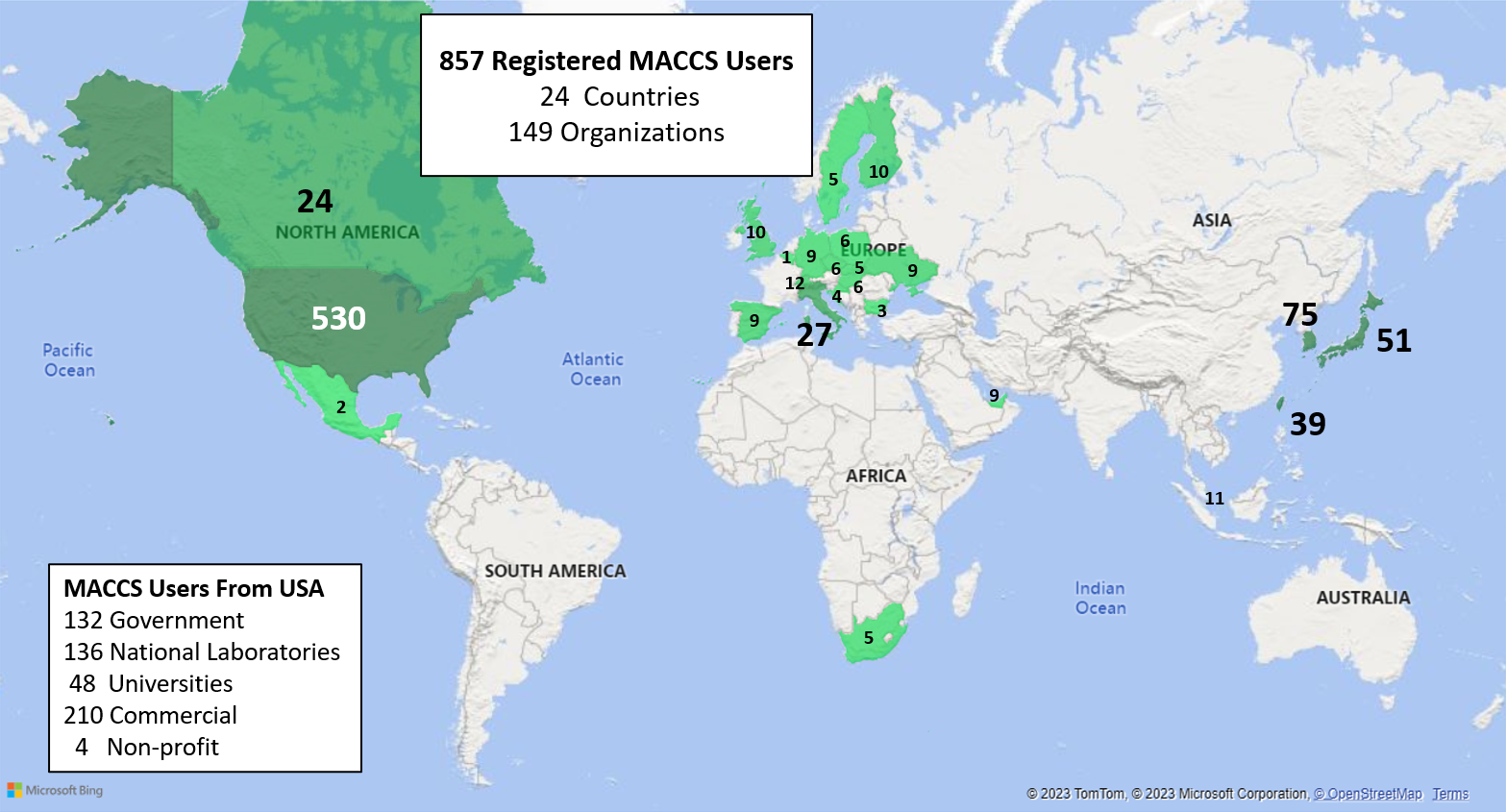
User Community
The MACCS user community includes both domestic and international users, to include the NRC, DOE, several research organizations, nuclear industry licensees/applicants, and academic institutions. Primary uses of MACCS include performing regulatory cost-benefit analysis, environmental analyses of Severe Accident Mitigation Alternatives (SAMAs) and Severe Accident Mitigation Design Alternatives (SAMDAs), evaluations for emergency planning, Level 3 PRA studies, consequence studies, and other risk-informed activities.
Downloadable Content
Product Key for all MACCS versions 4.2 and later, valid through March 2027.
MACCS-HYSPLIT Tools
DCF Threshold Data
Release Notes
MACCS Version 5.2.0
MACCS-UI 5.2 contains several new features and improvements to 5.1, including:
- Expanded characters allowed in a input file CARD to 9999 vector elements. Also increased the maximum number of plume segments to 999.
- Added new EARLY/Output Contol/Protective Actions Projected Dose forms for new Protective Actions Projected dose early phase output request and the analogous CHRONC forms for late phase output requests.
- Added Skin deposition pathway “SKIN AC” to result output pathway lists in the EARLY/Output Control/Centerline Dose form PATHNM variable and to the Ambient Dose form PATHNH variable.
- Added a new print flag to cause the output to print doses per nuclide per organ per pathway.
- Overhauled the MACCS UI properties and input parameter tree to be more user friendly and compact, merging/moving/updating many forms.
- Added COMIDA version 2.0.0.5 to the MACCS UI installation, a new version of COMIDA allowing doses for up to 999 radionuclides.
- Significant upgrades to the report feature, including several new reporting options and other housekeeping items.
- Fixed many bugs from version 5.1.
- Implementation of numerous other quality of life and user experience features.
- Updates to relevant documentation.
MACCS Version 5.1.0
MACCS-UI 5.1 contains several new features and improvements to 5.0, including:
- Upgraded MACCS-UI to Java 21 from OpenJDK.
- Added new variable for long-term daily costs.
- Added new form for Dose Projection Shielding and Exposure with several new user defined protective shielding and exposure values, as well as intermediate and long-term phase protective shielding and exposure values.
- Implemented final uncertainty distributions forms that require a table input format.
- Significant changes to reporting/outputs including (but not limited to) a new standard report column format, clearer display of report options, printing of reports to comma separated value formatted file (easily opened in Excel), and a new complete report containing all requested outputs.
- Removed redundant forms, made existing forms more obvious.
- A new output for distance exceeding threshold (Type G).
- A new output for ambient dose (Type H).
- Added the ability to run MACCS-UI in batch mode from a python script.
- New functionality for significantly easier processing of HyGridConvert files.
- Addition of the Correlate Uncertain Variables form allowing MACCS-UI to display the uncertainty linear correlated variables and the ranked order variables and their coefficients.
- Updated “apply” and “undo” buttons on certain forms.
- Addition of a condemnation costs form, with the two new user defined waste cost for condemnation variables.
- Various other quality of life and state of practice updates.
- Various bug fixes.
MACCS Version 5.0
MACCS-UI is completely updated code release for the MACCS interface to address software obsolescence and other user interface improvements. Enhancements include the following:
- Modernize the software application with a modern system architecture, code design, and code reuse capabilities.
- Replace the Visual Basic framework with an Electron-based framework.
- Replace the Microsoft Access database with code data structures and the related code operations.
- Reduce code maintenance by deploying modular design principles and provide pathway for future MACCS improvements.
- Maintain the WinMACCS 4.2 functionality and backward compatibility with WinMACCS projects.
- Simplify and reduce the effort for completing input forms.
Additionally, the MACCS Code Suite will be undergoing a modernization effort in the next several years to update the underlying programming languages as well as expanding capabilities to consider new reactor designs.
MACCS Version 4.2
MACCS v4.2 is now available! Major enhancements for version 4.2 include the following:
- License key: The "Product.key" is provided with the "WinMACCS 4.2.0 Setup.exe" file and is no longer locked to a specific computer. This allows MACCS to run on multiple computers with the same license key, including for cloud computing.
- Cleanup criterion: A new dose-dependent cleanup criterion allows users to model the acceptable cleanup level of contaminated areas. This now allows users to model decontamination in lightly contaminated, habitable areas in addition to interdicted areas.
- Dual dose criteria: Users now have the ability to model two relocation criteria in the long-term phase. This allows users to model two dose criteria (e.g., 2 rem in the first year, 0.5 rem in the second year) to make a single relocation decision, reflecting the US Environmental Protection Agency’s protective action guides.
- Hotspot and normal relocation: Users now have two additional ways to model dose projections for early phase hotspot and normal relocation, "TOTAL" and "AVOID". "TOTAL" evaluates the total dose from all air and ground concentrations and "AVOID" evaluates the avoidable dose from ground pathways. These options are intended to mirror how decision-makers would evaluate doses during a radiological emergency using Turbo-FRMAC.
- RDEIM economic model: The new RDEIM model outputs have been updated to differentiate between gross domestic product losses and offsetting recovery gains.
- TEDE dose coefficients: MACCS now includes two sets of dose coefficients to estimate the effective dose, "ICRP60ED" (based on ICRP-60) and "TEDE" (based on ICRP-30).
- Radionuclide list: The limit to the number of radionuclides defined in MACCS has been changed from 150 to 999.
SAND2025-05197W